CDSCO e-Governance solution
How a national drug regulator cut license processing time 57% and cleared 3.2× more applications.
SUGAM — the national drug & medical-device regulatory e-governance solution for CDSCO that digitizes the full licensing lifecycle — turning couriered paper files into guided online applications, automated validation, reviewer workflows, and transparent, real-time approval tracking.
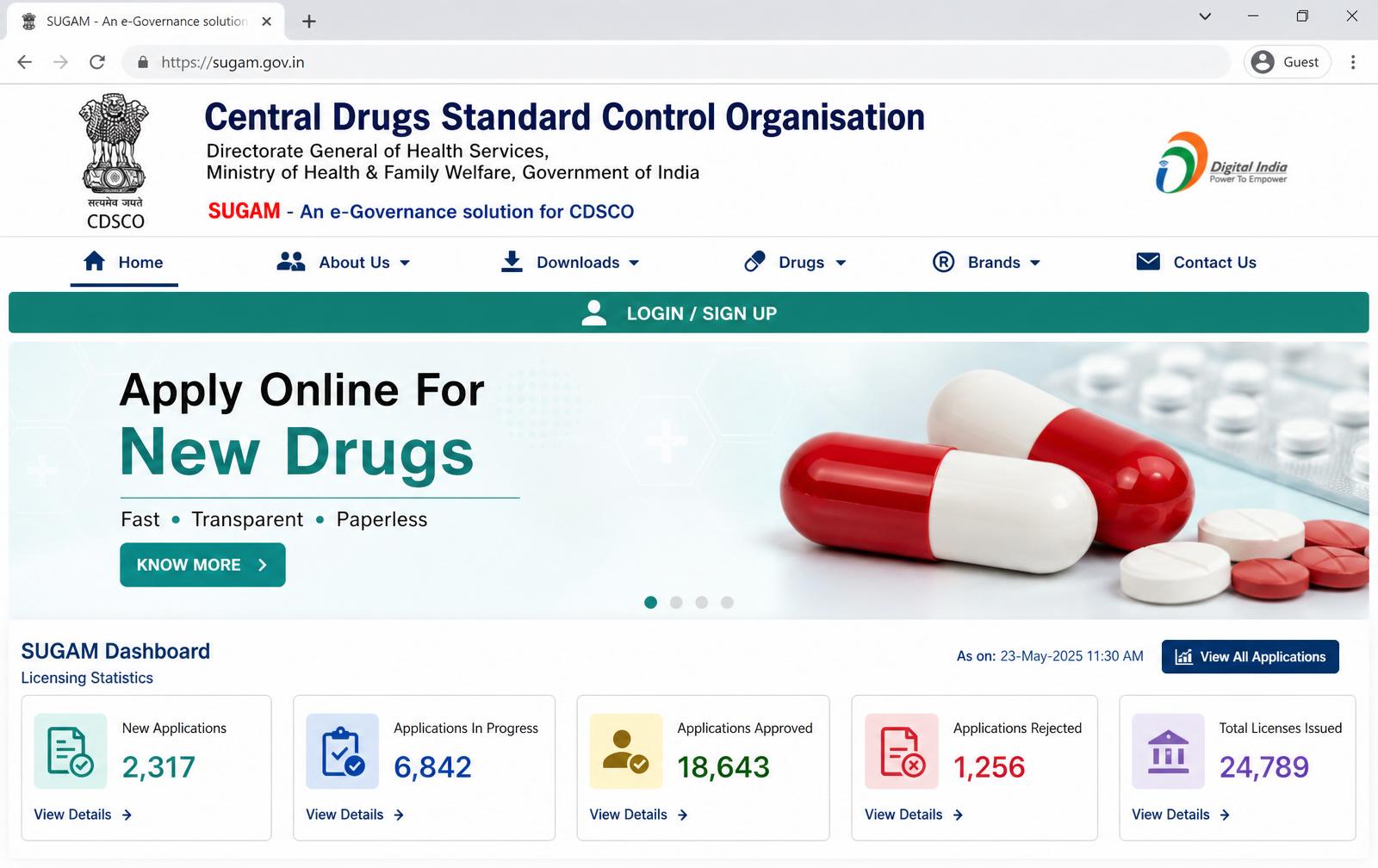
What the web application does
Six core capabilities turn a paper-bound approval process into a transparent, browser-based regulatory workflow — built for speed, consistency, and legal defensibility.
Guided online applications
A multi-step, category-aware form walks applicants through drug, cosmetic, device, or clinical-trial licensing — saving drafts, pre-filling from their entity profile, and eliminating physical file submission entirely.
Automated document & fee validation
Mandatory documents and statutory fees are validated on upload. The portal flags missing or invalid files before submission, so applications reach reviewers clean instead of bouncing back weeks later.
Role-based reviewer console
A configurable rules engine routes each file by category and risk to the right reviewer queue, with global search, side-by-side document review, and bulk actions for high-volume scrutiny.
Threaded query management
Reviewers raise clarifications online and the statutory clock pauses; every query and applicant response stays threaded against the file, replacing letters and phone calls with a single auditable conversation.
Inspection & SLA tracking
GMP and post-market inspections are scheduled, tracked, and linked to applications, while enforced statutory timelines auto-escalate any file that risks breaching its SLA.
Digitally-signed e-licenses & audit trail
Approvals issue a tamper-evident, digitally-signed e-license that's instantly verifiable, and every action on every file is written to an immutable, timestamped audit log for legal defensibility.
Explore the live web application
A working slice of the CDSCO portal, rendered as the real regulator app-shell. Switch the time range to watch the pipeline, KPIs, and category chart respond. Hover any glossary term for a plain-language definition.
Central Licensing Authority overview
Live regulatory workload · This Month · as of May 2024
Filed vs. cleared
last 6 monthsBy category
This MonthRegulatory insights
SmartFor this month, 756 licenses were approved while 892 remain under review and 312 await applicant responses to raised queries. Drugs and medical devices account for the largest share of filings. Average processing time continues to fall as physical file movement is eliminated and queries resolve online. 178 applications have breached their statutory timeline and are auto-escalated for priority action — recommend reassigning the oldest 20 to available reviewer queues to protect SLA compliance.
Latest license applications
| Reference no. | Applicant | Category | Status |
|---|---|---|---|
| NMMDA/DRUG/24/05123 | Mankind Pharma Ltd. | Drugs | Under Review |
| NMMDA/DEV/24/04987 | Siemens Healthcare Pvt. | Medical Devices | Query Raised |
| NMMDA/DRUG/24/04912 | Sun Pharma Laboratories | Drugs | Under Review |
| NMMDA/COS/24/04876 | Himalaya Wellness Co. | Cosmetics | Submitted |
| NMMDA/CT/24/04654 | Tata Memorial Hospital | Clinical Trials | Query Raised |
| NMMDA/DRUG/24/04532 | Cipla Ltd. | Drugs | Approved |
Inspection schedule
- Scheduled
Baddi, Himachal Pradesh
21 May · GMP Inspection
- Scheduled
Hyderabad, Telangana
22 May · GMP Inspection
- In Progress
Ahmedabad, Gujarat
23 May · GMP Inspection
- Scheduled
Pune, Maharashtra
24 May · Post-market
- Completed
Kolkata, West Bengal
27 May · GMP Inspection
Terms glossary
plain-language definitions for every term on this portal- GMP Inspection
- Good Manufacturing Practice audit verifying a facility meets quality-manufacturing standards before or during licensing.
- Query Raised
- Reviewer has requested clarification or additional documents; the statutory clock pauses until the applicant responds online.
- SLA Breach
- An application that has exceeded its statutory processing timeline and is auto-escalated for priority action.
- e-License
- A digitally signed, tamper-evident license issued on approval — legally valid and instantly verifiable online.
- Application Pipeline
- The end-to-end status flow every file moves through: submitted, under review, query raised, and approved or rejected.
- Audit Trail
- An immutable, timestamped log of every action on a file, making each regulatory decision fully traceable and defensible.
The Challenge
The national drug regulator processed licenses for drugs, cosmetics, medical devices, clinical trials, and imports on paper files couriered between state and central offices. Applicants could not see where a file was stuck, reviewers re-keyed data from PDFs, and identical documents were demanded repeatedly — turning routine approvals into months-long waits for 48k+ regulated entities.
What We Learned
Field visits to zonal offices showed the bottleneck was not review effort but coordination: files waited in queues, queries travelled by letter, and status was a phone call. Applicants wanted certainty more than speed; reviewers wanted clean, validated data and a defensible decision trail. Two very different expert users had to be served by one platform.
The Strategy
Move the whole licensing lifecycle online as a responsive web portal — dense tables, side-by-side document review, role-based queues, and long desktop sessions are work no mobile-only experience could carry. An accessible, WCAG-compliant institutional design system ties it together: a role-aware sidebar, a status-driven application pipeline, a document-validation panel that flags issues on upload, and threaded queries kept against the file. Semantic status tokens — submitted, under review, query raised, approved, rejected — mean the same thing in every module.
How It Was Built
A configurable rules engine routes each application by category and risk to the right reviewer queue, auto-validates mandatory documents and fees on submission, enforces statutory timelines with escalation, and writes every action to a tamper-evident audit trail. The applicant journey — guided multi-step form, online submission, automated validation, reviewer scrutiny, threaded query, digitally-signed e-license — shows live status at every stage.
The Impact
Median license processing time fell 57%, 3.2× more applications were cleared with the same staff, and 92% of submissions went fully paperless. 48k+ regulated entities gained transparent, real-time visibility into their applications, and every decision became legally defensible through the audit log.
What I Carry Forward
In GovTech, transparency is the feature that earns trust: showing applicants exactly where their file sits removed the largest single source of frustration and follow-up calls. Guardrails — validation on upload, enforced timelines, an immutable audit log — let a public body move faster while staying fully accountable.
Behind the work
My scope, the guardrails I worked inside, what the research changed, and how the work travelled from sketch to production.
My role & scope
Lead product designer for the regulatory portal: stakeholder interviews with regulators and applicants, end-to-end submission and review flows, the document-state model, and an accessible government-grade component set.
Constraints & guardrails
- Statutory process and terminology fixed by regulation; wording changes needed formal approval.
- Public-sector accessibility obligations and support for older browsers and low-spec devices.
- Applicants ranged from large manufacturers to first-time filers with no domain training.
- Legacy backend forms dictated field structure for the first release.
What research changed
- Applicants could not tell where a submission stood — most support calls were status enquiries.
- Reviewers rejected filings mainly for document format errors that could be caught before submission.
- Testing showed statutory language needed a plain-language companion, not a replacement.
The pivot
An early redesign rewrote regulatory labels in plain English and failed review. We reverted to statutory wording with an inline plain-language explainer beside each term — compliant and comprehensible at once.
UX metric → business impact
Process maps of the statutory journey with rejection reasons overlaid from historical filings.
Prototype with document-state machine, validation messaging and screen-reader annotations.
Live portal: application tracker, reviewer queue and compliance dashboards.
Retrospective
Test with first-time filers earlier; expert applicants masked comprehension gaps that only novices hit.
In statutory products, clarity is additive — keep the legally required language and layer understanding beside it rather than over it.
“Applicants stopped calling to ask where their file was. That one change took more load off the zonal offices than any staffing decision we made.”