Merchant Onboarding - B2B
How a national acquiring bank cut merchant time-to-live 42% and lifted approvals 18 points.
An enterprise onboarding platform that gives PNC merchant-services teams real-time visibility across the full six-stage pipeline — with a GenAI layer that validates documents, surfaces risk in plain language, and gets legitimate merchants live faster.
Merchant onboarding process
Six key steps take a merchant from first document to first payment. The dashboard maps one-to-one onto this flow so every drop-off is traceable to a real stage.
Pre-onboarding preparation
Gather required documents — business details, tax ID, ownership info, and financial statements — with GenAI checklists that flag gaps before submission.
Merchant application
Submit the application with business details and transaction expectations through a guided, auto-validated form.
Compliance & risk assessment
The PSP / acquiring bank reviews compliance, performs KYC/KYB checks, and evaluates risk with explainable AI signals.
Account setup & integration
Connect the merchant platform to the PSP or payment gateway for seamless, tested payment processing.
Training & support
Merchants receive training on using payment systems and managing transactions, with in-context help.
Go live
Start accepting payments securely and efficiently, with ongoing monitoring for compliance and optimization.
Ongoing monitoring ensures compliance, security, and optimization of payment systems well beyond go-live.
Explore the live dashboard
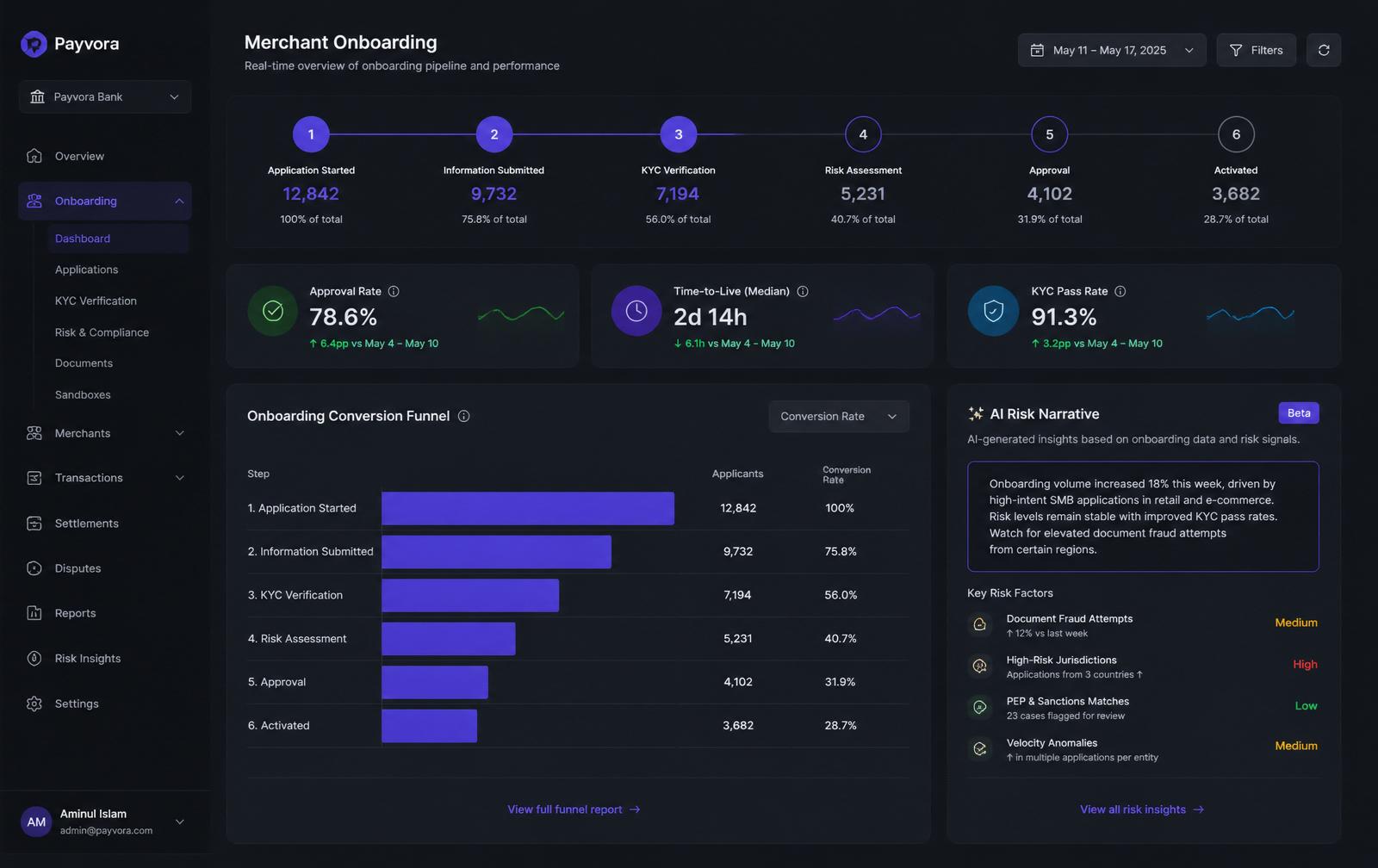
A working slice of the product. Switch the time range to watch the onboarding funnel, KPIs, live risk signals, and the AI agent assistant respond in real time.
Merchant Onboarding · Live Demo
PNC Merchant Services · as of May 2025
Onboarding Conversion Funnel
7D · applicants per stageLive Risk Signals
from KYC / KYB engine- Medium
Document fraud attempts
+12% vs last week
- High
High-risk jurisdictions
Applications from 3 countries ↑
- Low
PEP & sanctions matches
23 cases flagged for review
- Medium
Velocity anomalies
Multiple applications per entity
Metrics glossary
plain-language definitions for every metric on this dashboard- Approval Rate
- Share of started applications that pass compliance and reach an approved decision. Higher is better, as long as risk controls hold.
- Time-to-Live (median)
- Median elapsed time from application start to a merchant going live and accepting payments. Lower means faster activation.
- KYC Pass Rate
- Percentage of merchants that clear Know-Your-Customer / Know-Your-Business identity and ownership verification on first pass.
- Docs Auto-Verified
- Share of submitted documents automatically classified and validated by the GenAI document-assist layer without manual review.
- KYC / KYB
- Know Your Customer / Know Your Business — regulatory checks verifying the identity, ownership, and legitimacy of a merchant before onboarding.
- PEP & Sanctions
- Screening against Politically Exposed Persons and global sanctions lists to prevent onboarding prohibited entities.
- Velocity Anomaly
- An unusual pattern such as many applications from one entity in a short window — a common fraud and abuse signal.
- Conversion Funnel
- The count of merchants remaining at each onboarding stage, revealing where applicants drop off.
- pp (percentage points)
- The absolute difference between two percentages. +6pp means a rate rose from, e.g., 72% to 78%.
From challenge to outcome
The Problem
What We Learned
The Strategy
How It Was Built
Accessibility
The Impact
What I Carry Forward
Structure, flow & fidelity
How the product was organised, the path a user actually takes through it, and how the work travelled from scratch wireframes to a working prototype.
Information architecture
Application
- Business profile
- Ownership & KYC
- Bank & payout
- Review & submit
Verification
- Document upload
- Automated checks
- Manual review queue
- Status timeline
Support
- Save & resume
- Inline help
- Requirement explainers
- Contact
Post-approval
- Account setup
- Pricing & fees
- First transaction
- Dashboard handoff
User flow of the core task
- Step 01
Start application
Merchant sees the full scope and expected time before entering data.
- Step 02
Complete a step
One decision per screen, with each requirement explained where it is asked.
- Step 03
Upload documents
Live validation catches problems before submission, not days later.
- Step 04
Track verification
A transparent status timeline replaces the silent waiting period.
- Step 05
Get activated
Approval hands straight off into account setup and first transaction.
Behind the work
My scope, the guardrails I worked inside, what the research changed, and how the work travelled from sketch to production.
My role & scope
End-to-end design ownership: applicant research, the multi-step onboarding flow, form architecture, error and recovery states, and the reviewer-facing counterpart. Worked directly with the platform PM and 3 engineers.
Constraints & guardrails
- Regulatory fields could not be removed — only sequenced, explained and progressively disclosed.
- Mobile-first for small merchants on low-bandwidth connections.
- Document upload quality gates imposed by the KYC vendor.
- Localisation-ready copy with no fixed-width labels.
What research changed
- Funnel analytics showed a 40% drop-off at the business-details step — cognitive overload from a single long form.
- Interviews: applicants abandoned when they had to leave to find a document with no way to resume.
- Usability testing showed vague validation errors, not the fields themselves, caused most retries.
The pivot
The original single-page application form tested at heavy drop-off. We split it into a staged wizard with save-and-resume, plain-language field help, and inline validation that names the fix rather than the failure.
UX metric → business impact
Flow diagrams and paper wizard steps tested with six small-business owners.
Interactive wizard prototype with full error, upload-failure and resume states annotated for accessibility.
Responsive onboarding flow with progress, contextual help and the reviewer queue it feeds.
Retrospective
Ship analytics on field-level abandonment in the first release — we inferred the overload point before we could measure it precisely.
You rarely get to remove regulated fields, but you can always change their sequence, framing and recovery path — that is where completion rates move.
“Analysts used to guess where merchants were stuck. Now the funnel tells them, the document check clears the easy files, and the queue is only genuinely risky work.”